Sumac Over the Pond

Sumac Over the Pond

January 26, 2015

OUR RESIDENT THREE LEGGED DEER

My hubby took this pix this morning when the snow was lightly falling just west of our cabin.  A three legged deer is on the right, her sidekick is on the left.  They are nearly always together.

Last fall our yard had an abundance of red oak acorns falling on the ground like marbles.  It was one of those years when you had to be careful where you stepped for fear of sliding on your backside and careful where you stood when hanging clothes on the clothesline.  A plunk on top of the head by a falling acorn stings!

With so much acorn "candy" in our yard, we began seeing deer during daylight hours feeding close to our cabin.   But one deer stood out among the rest, a doe with a good portion of her front leg missing.  Her stub leg showed no sign of injury or infection and appeared to be fully healed over.  Another younger deer always stood by her side, a doe that was probably her fawn.  Did she loose her leg after being struck by a car?  Was her leg tangled in a fence? Did she have a narrow escape from a wolf attack?  We'll never know her story.

To this day our three legged deer keeps showing up in the yard and often beds down in tag alders near the house.  Every time we spot her, the doe fawn is nearby.  It seems as though the fawn has a mission to keep an eye on the older deer.  The young deer may well be helping the older one survive the winter.


Often at night we hear deer kicking away snow and crunchy leaves searching for buried acorns near our bedroom window.  We've woke up in the night several times hearing the deers scratching sounds.  Looking out our window in the moonlight we've seen the three legged deer with her buddy just a few feet away.  With one front leg missing, foraging through snow has to be difficult for her.  Maybe the fawn kicks away a little larger area of snow so the three legged deer can find acorns too, perhaps unknowingly, but one is definitely aiding the other. 


So far our three legged deer looks healthy and plump and she seems to have adapted fairly well to her handicap.  Running is difficult for her, but she throws herself forward at a pretty fast pace when she feels the need.  When I think of our zub-zero temps and lack of feed in harsh winters, it's a wonder that even healthy whitetail deer make it through.  Although this winter has been relatively mild so far, at least in January, this three legged deer is a true survivor.

Just checkin' to see if anybody's observant... here's a little track and treasure spotted on a walk the other day!

January 20, 2015

BIRCH TREE SEEDS ON THE SNOW

This past weekend we had our January thaw, an expected but not always given mid winter treat.  A January thaw gives you a chance to take a long walk outside and serves as a reminder that winter will not last forever.  Saturday on my walk I noticed hundreds of little seeds atop the snow underneath this birch tree. I love the patterns created on birch tree bark, this tree is no exception.


I've probably seen these little flecks atop the snow many times before, but today they caught my eye with their little tan and brown bird like shapes.  Brisk winds from the past couple of days more than likely caused them to scatter from the tree tops to the snow covered ground.

After kneeling down and looking at the little bird like shapes and wondering what they were all about, I took a few photos of them.  

The paper birch tree as shown above has seed pods called catkins that hang from the outer edges of it's branches.  The catkins, when mature, come apart, and fall to the ground.  They have a stem in the center with "separators" and seeds in between them that remind me of shish kabobs.

Each catkin can hold over a thousand birch tree seeds.  The separators are the bird shaped pieces and the seeds are round with what look like two wings attached to them.  Birch tree seeds fall off the trees from August all the way through the following winter months.  The seeds provide food for winter birds but most of all they just want to turn into little birch trees.

Next time you go for a winter walk with snow cover, look under a large birch tree and maybe you'll see the little bird shaped pieces and birch tree seeds scattered all around you on the ground.  I marvel at the little things in nature that can turn into big things like a beautiful paper birch tree.


January 12, 2015

WINTER SUNSETS AND MOURNING DOVES


It was another spectacular winter sunset at home last evening.  I've enjoyed several beautiful ones this winter as I look out over our pond where the sky starts out with a brilliant orange hue and turns pink as the sun disappears below the horizon.

This time of year my hubby puts an electric aerator in the pond to keep an area of water open.  When the snow covers the ice it cuts off the sunlight, causing plant material in the pond to die and begin to decompose.  This process robs oxygen from the water, taking it away from the fish, and will eventually cause "winter kill".  We have good success with the aerator, so generally not long after the New Year it starts to hum.

As soon as an opening of water appears, we begin to notice mourning doves as they fly in to quench their thirst each evening at dusk.  They arrive in groups of a dozen or more and land in the trees at the pond's edge.  A red pine tree is their favorite gathering place.  The doves seem to take turns, flying back and forth from their roosts in the trees to the open water, making beautiful twittering sounds all the while in flight.


My uncle called mourning doves "rain crows".  Their cooing sounds in warmer seasons is said to be a sign of rain in the near future.  The gentle sounds the doves make are always comforting to me.  They are very shy birds when they land on the pond and scatter quickly when we walk near them.  I'm amazed at how they can get close enough to drink without falling in!

January 5, 2015

CABIN FEVER

Here's a poem about the illness that affects most nature loving Wisconsinites this time of year...


Since it's much too cold to journal outdoors for my blog this week, I decided to dig up an old poem for you that I wrote last winter.  It fits my mood.  Everyone who lives in the north woods knows what cabin fever is.  It strikes you when winter gets so cold that you can't enjoy the outdoors the way you'd like to.  It comes along when you are fed up to the ying yang with those short days, long nights, and cold temps and you want to scream...  I CAN'T TAKE THIS ANYMORE!

It's still early winter, so most cases of cabin fever are mild ones yet.  It was only 23° below zero this morning.  Wait til late February or early March and cases will become more prevalent.  In the most severe case, there is no cure, until one sees pussy willows.


CABIN FEVER


Wisconsin winters, firewood splinters
Christmas lights, starry nights

Smokey stoves, birchwood groves
Wood pile shrinking, outhouse stinking

Drippy nose, frozen toes
Chapped lips, frozen fingertips

Mittens and caps, afternoon naps
Frizzy hair, thermal underwear

Fogged up glasses, cold as molasses
Animal tracks, snowmen when it packs

Fishing on ice, shacks are nice
Skis on snow, go Pack go

Shorter days, lazier ways
Winter's long, like a boring song

Nobody's friend, when will it end
Cabin fever, love it or leave her


Keep your thoughts warm and cheery, put your headlamp on, 
and think about pussy willows.


December 28, 2014

SNOWFLAKES ARE SPECIAL


APPRECIATING THOSE LITTLE THINGS


I'm slacking today, writing my blog in the warmth of our cabin.  It's that time of year when you're beginning to settle into winter.  You know you can't deny it any longer, so you might just as well find something warm and wonderful about it.  We really don't have to look too hard to appreciate winter in Wisconsin if we give it a little effort.

A few days ago a dear friend, Dorothy, from Montana, sent me a really neat book, "The Snowflake, Winter's Secret Beauty", by Kenneth Libbrecht.  This book includes many awesome closeups of snowflakes taken by photographer, Patricia Rasmussen, in Wisconsin.  I'll give it 5 stars!  

I learned so much about how snowflakes are created and it's indeed true that no two flakes are alike, kind of like identical twins.  Although you might think they look just the same, if you check them out closely you'll be sure to find slight differences.

As I looked out the window this afternoon I noticed a few light snowflakes drifting to the ground.  This prompted me to head outdoors with my camera and try to capture a few amateur photos of snowflake crystals and/or freeze my fingers, just for fun.  I stood near dark surfaces flakes might land on and waited patiently... yes, I need more practice, but here are my best shots.

I also learned from Libbrecht's book that all snowflakes are hexagonal or six sided.  Rarely, when two flakes share a center, they may have twelve arms, but never four or eight.  Snowflakes are symmetrically perfect because as they grow larger, while passing through the atmosphere, each arm of the flake goes through the exact same conditions.

I am fascinated when I think of how the depth of snow on any surface is made up of millions of tiny snowflakes stacked on top of one another.  It's kind of like a sand dune made possible only by the piling up of billions of tiny grains of sand.

If you get a chance, hold out your mitten during a snowfall and really look hard at those tiny snowflakes as they land on it.  I know you've done this before when you were a kid, but just do it again!  Each snowflake you see will be unique to itself and each one will have six arms... unless it was broken on its amazing trip from the sky... to you! 


Thank you, Dorothy!

December 21, 2014

THE FIRST DAY OF WINTER

A FAVORITE MAPLE TREE OF MINE

I found a seat in an old maple tree by Tom's Creek late this afternoon where I can sit with my journal and celebrate the first day of winter.  It's 35 degrees, cloudy, foggy, and gray, and there's very little snow on the ground!  There will be no sunset for me to notice since the sun has been hiding under the clouds all day, like for most of December, it seems.


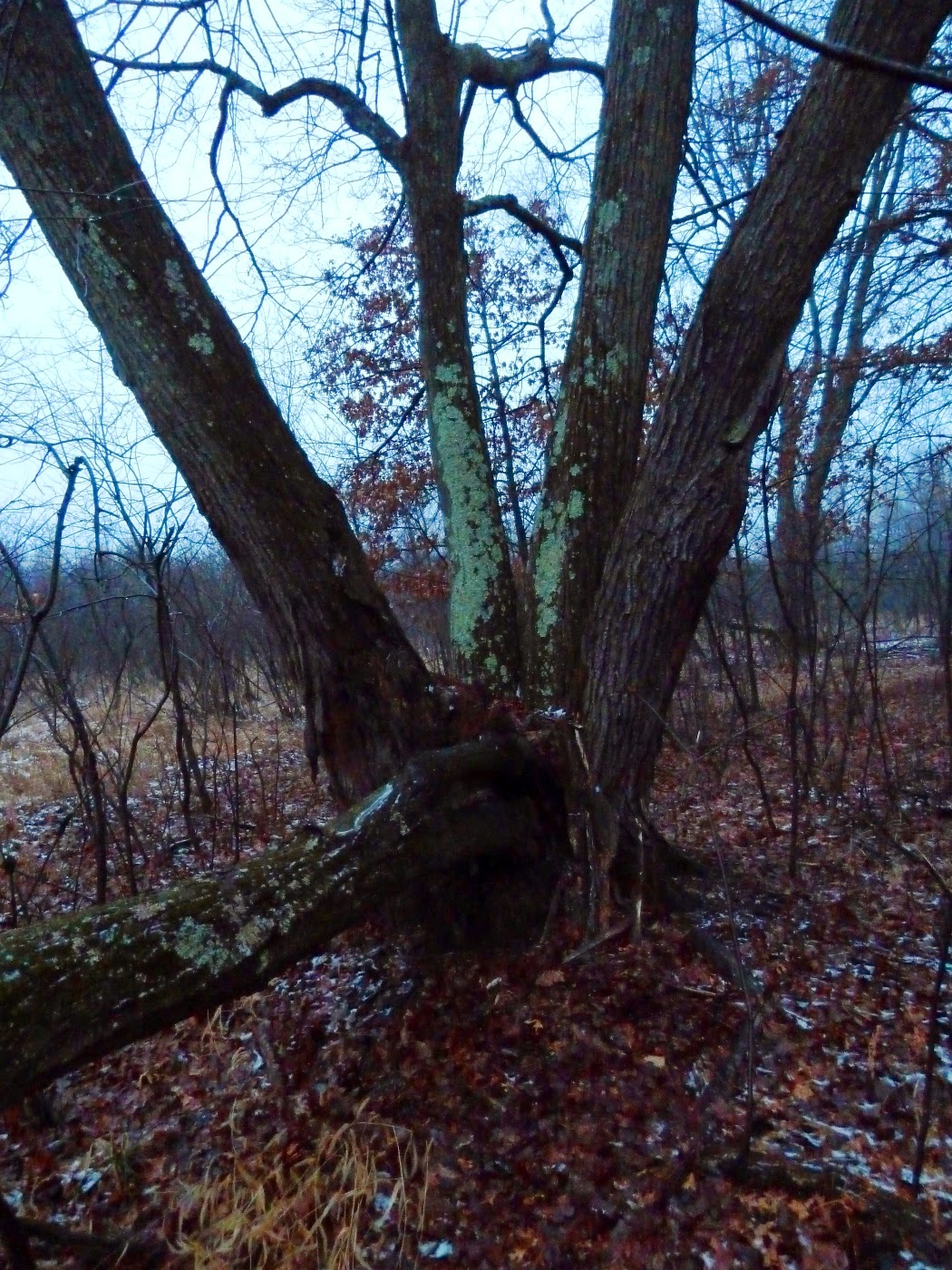
I appreciate this maple tree.  It's kind of like a family of five trees joined together at the base with each tree spreading out into the world on its own, except for one that's now broken with it's branches resting on the ground, sprawling toward the creek.

A slight mist fills the air and I can hear an occasional drop of rain hitting the earth beneath me or landing on the hood of my coat.  The creature world is silent.  Not even the sound of a blue jay, crow, or chickadee do I hear.  Perhaps the birds are busy at home getting ready for Christmas.

This maple tree reminds me of a family with one member gone, but the one that is gone lives on in the memory of those still standing tall.  Green lichen grows yet on the bark of the downed tree, chipmunks still scurry across its trunk, and it gives me a place to sit and ponder.  Same with our missing family members... although they are apart from us, we will forever remember, and forever be one.


As I dawdle back through the woods towards home, the daylight is nearly gone.  It's that time of day when every bit of brush turns into a deer, every clump of marsh grass turns into a tail, and oak leaves yet fastened to the treetops turn into birds flitting in the wind.  

When I arrive back at our cabin, my dawdling has paid off.  The light in the kitchen is on and the fish we're having for supper have all been cleaned.  Life is good!  

Merry Christmas to all my nature loving friends, and thanks for following my blog!

December 15, 2014

DECEMBER RAIN

SITTING ON THE BANK OF LINDSAY CREEK

This afternoon my hubby said rain was on the doorstep, so we both shoveled each other outside to enjoy this mild but foggy 44° December day.  While he went ice fishing, I headed off into our now snowless woods, journal and camera in pocket, looking for a spot along the creek wherever water might be making some of those pleasant babbling, gurgling, sounds. 


After a short jaunt, I find myself sitting with pen in hand, listening to beautiful music where water trickles over a small clump of twigs and leaves as it glides down Lindsay Creek.  Now and then a melting drop of ice kerplunks into the water.  I'm fascinated by a circle of foam in the middle of the creek that keeps swirling around and around in one fixed spot, with seemingly no way to escape.  It hypnotizes me, but only for a moment.


There's something about a little creek in the woods.  Although there are no fish to catch in this one, there are minnows and smaller critters to appreciate now and then.  In summer, wood ducks land here occasionally for a brief refuge.  In winter, fox, otter, and even wolves use the frozen ice atop the creek for their highway.  You just have to look close, and listen, to appreciate the creek's magic.

Extra cold November temperatures froze Lindsay Creek up earlier this season, but today water flows over top what little ice remains.  The clear and sometimes root beer colored water is in a hurry today as it quickly swirls past me, meandering on through the woods toward the East Fork of the Black River. 


Lindsay Creek gets its name from an absentee landowner who owned a huge chunk of property in the late 1800's north of here near the creek's beginning.  His name was Freeman D. Lindsay, a Civil War veteran and lumberman.  Although this creek has no official name, and is too small to show up on most maps, I like to keep up tradition in referring to it with the same name the old timers gave it.  I think of Lindsay Creek as a little creek with a big heart.  Maybe Freeman is looking down on me today while I write in my journal, in December, with no gloves on, and pretty soon he'll knock that swirling circle of foam loose so it can float on down to the Mississippi.

Here comes that December rain.  Lindsay Creek and I don't mind as the pleasant memories of this very mild day will make winter that much shorter!


If you have a little creek nearby, take time to sit on its bank, in any season.  Running water, like a flaming bonfire, can captivate your eyes and mind and give you a sense of peace, no matter what is troubling you.

December 7, 2014

ON WINTERGREEN HILL

WINTERGREEN BERRIES & WINDFALLS

As I journal today on our back twenty, near wintergreen hill, a cackling squirrel scoots down a nearby oak tree.  He fades into the forest with a mysterious morsel in his mouth.  Temps are in the 30's and there's an extreme stillness in the air.  It's so quiet I can hear my pencil squawk as I write, and that upsets me.  It's not a sound that fits into the moment.


I watched an owl fly overhead on my walk to little wintergreen hill this afternoon.  The majestic owl was being harassed by a couple of crows, the usual ones you know, like people we call bullies.  I know the owl will be alright; we can't change the nature of the bully crows.  It's better to reflect on how beautiful their feathers shine in the bright sunlight then to dwell on their meanness.  


This little bump in the woods that I sit by is covered with wintergreen leaves and their sparse but red, delicious berries.  That's how it got it's name.  My sister calls wintergreen berries nature's breath fresheners.  They have a delightful and mild, minty taste.  Today a couple inches of snow cover up the green leaves of the wintergreen plants... but I know they'll reappear in the springtime as soon as the snow thaws. 
 
How did wintergreen hill come to be?  I'd guess it was created over a hundred years ago by a windfall, a large tree blown over by high winds, leaving it's huge root mass jutting out atop the ground.  Although it may appear to be an insignificant bump in the woodland floor, it's an important landmark to me simply because I can always count on it being there.  If you're a woodland walker, you'll know what I mean.

As the sun sets, a chill comes over me, prompting a walk back to a warmer spot.  I hope the owl has found some peace and quiet by now... I know I have.


November 30, 2014

HALF OF A MOON


                    Last evening, after the sun had set, I noticed a half moon in the sky. The moon reminded me of a poem that came my way one night when sleep wouldn't.  I kept the poem alive until morning and then jotted it down so I wouldn't forget it. Why, I don't know!  It's a good example of the nonsensical thoughts that run through a person's mind when sleep doesn't come easily, nonsensical thoughts and silly dreams that usually escape you as quickly as they come, thank goodness!  Except for this one...

  MOON THOUGHTS WHEN I CAN'T SLEEP

I cut the moon in half with a butter knife last night,
And since I made that crooked slice
I let you choose which half you wanted.

You took the east side, so I took the west.

I placed my half of the moon up high in the sky
And I let it's light guide me through the trail in the woods,
To the creek, where the water glistened.

I sat for a spell and listened for the wolves, but they weren't howling...
So I let the light from my half of the moon lead me back home.

Then I snatched it and pulled it down from the sky.


I slipped off my boots when inside my cabin door,
And laid my half of the moon on the kitchen table.

With my butter knife I spread cream cheese on a bagel,
And I nestled my half moon on top of it.

Then I climbed into bed and slept peacefully,
Savoring thoughts of a sweet breakfast treat in my dreams.

What did you do with your half of the moon?


My favorite socks my daughter-in-law knitted for me!


November 23, 2014

OPENING DAY of the WISCONSIN GUN DEER SEASON

SNOW FLEAS ON THE TRAIL TO AN OLD DEER BLIND


It's a balmy opening weekend, with temps in the 30's and 40's.  I'm thrilled with this heat wave after a few weeks of way below average temps.  This warm opening day of the Wisconsin gun deer season gives me a chance to journal out in the woods. 

A few eerie sounding crows have noticed me as I sit in my blaze orange coat leaning up against an oak tree on the back twenty.  I chose this spot to ponder as it is next to an old ground deer blind, a favorite hunting spot for Arnie, a deer hunter and family friend I knew all my life.  He hunted right up until the spring he passed away from pancreatic cancer a couple years ago. 


Arnie was a visiting guest deer hunter with my family for over sixty years.  His zest for hunting, the stories he told, and the kindness he bestowed on all of my siblings won't be forgotten.   Arnie was one of those old fashioned hunters that made sure you were up way before the crack of dawn, not just on opening day, but every day he was there to hunt.  He carried a flashlight, a hunting knife in a sheath, a hatchet, and a plastic bag.  And he knew how to cook. 

I'm missing a few things today besides Arnie...  a good stash of candy bars, a drag rope, a gutting knife, and my 30-30.  I haven't hunted in several years, but I'm thinking next year I just might give it a try again.  My oncologist said at 2 1/2 years I could have my chest port yanked out so I'm holding her to that.  It sits in my upper right chest where the butt of my gun should be. 

I hoped to find snow fleas on my walk to this spot, and BINGO, they're everywhere!  Snow fleas are little black insects with spring-like tails.  They look like pepper sprinkled on old snow, but they leap about everywhere in constant motion.  I love snow fleas because I associate them with mild winter days and little things no one seems to notice.   If you open your eyes you can find them on a warm winter day, hopping atop the snow in a Wisconsin woods.  Often they appear on a trail that someone traveled before you did.


It's foggy this early afternoon.  I don't hear any gunshots, only crows and blue jays calling in the distance, so I'm guessing neither hunters or deer are moving.  Blaze orange hats off today to Arnie, and all the deer hunter guests from seasons past who have come into our lives for a few days every November.  They've not only shared the gun deer season experience with us through the years, but have created a lifetime of memories, traditions, and unfading hopes of shooting that dream buck.  Perhaps I will... next year!